
The Most Important Things to Check on a Used Motorhome
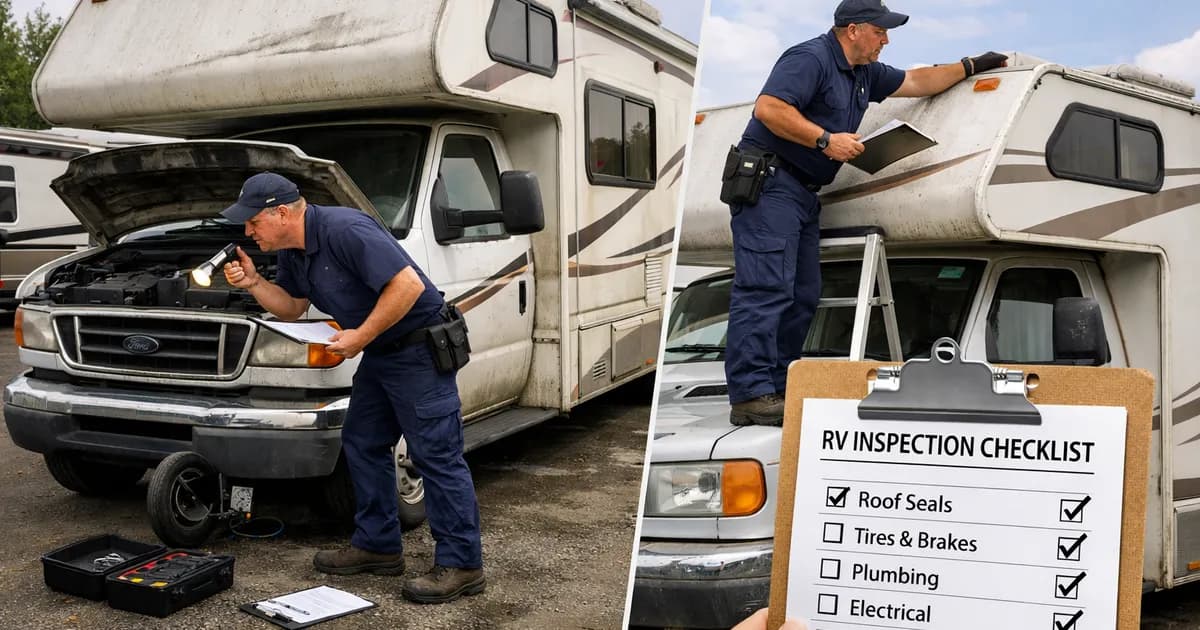
Checking a used motorhome is like inspecting a car and a house at the same time. It has both a mechanical side and a living area, and both can hide expensive problems. You do not need to be an expert. You need to know where to look and have enough time to look properly.
How do you check the roof and seals on a used motorhome?
Start at the top. If you can, climb onto the roof (carefully and only if the structure allows it). Look for cracked, dry, or silicone-patched sealant. Check around every skylight, every antenna, and every air vent. Any crack in a seal is a potential water entry point.
If you cannot get onto the roof, inspect it from inside. Look for water stains, areas with a different shade, or any sign of past moisture. Run your hand over the ceiling and feel for soft spots. If any area gives under pressure, water has been there. Sealants have a service life of between 5 and 10 years, and many used vehicles come with sealants that are well past their best.
How to detect damp inside a used motorhome?
Use your nose and your hands. Open every cabinet, look behind the cushions, lift every mattress, and check under the dinette benches. The places with poor airflow are where mold appears first. If it smells musty or damp, there is a problem.
Pay special attention to corners, to the areas where the walls meet the ceiling, and to the spaces around the windows. Touch the walls and feel for soft or swollen areas. In a healthy motorhome, the walls are firm and even. If you find soft patches, the damage may have been progressing for some time even if there are no visible exterior signs.
What should you check on the engine of a used motorhome?
Start it cold. Ask the seller not to start it before you arrive. Check whether it starts easily, whether there is smoke, and listen to the engine noise. Check the oil and coolant levels. Milky oil or coolant with oil residue is a sign of a blown head gasket. Look under the vehicle for stains and leaks.
Most motorhomes have diesel engines that can last a lot of miles if they are properly maintained. But the timing belt, clutch, and brakes need to be up to date. Ask for invoices for these repairs. If there are none, that expense is still ahead of you.
- Drive it in both city traffic and on the highway. Motorhomes are longer, taller, and heavier than a car, and any mechanical issue feels different.
- Pay attention to whether the steering pulls to one side, whether there are vibrations, and how the gearbox responds.
- Brake hard. In a loaded motorhome, weight is crucial: brakes that “work” in a car may be inadequate in a 3,500 kg vehicle.
- Test it on a hill. Listen to the engine at different speeds and look for blue or black smoke, which can indicate engine problems.
What should you check on the tires of a used motorhome?
Look at the manufacturing date in the DOT code on the sidewall. From 5 or 6 years onward, it is wise to replace them, even if the tread still looks good. Check that there are no sidewall deformities or uneven wear. Four motorhome tires are a significant expense that must be added to the purchase price if they are already past their best.
How do you check the living systems in a used motorhome?
The living area is what makes a motorhome different from a simple van. Every system has to work in all its modes, not just one.
- Gas: ask for the propane system inspection certificate. The gas inspection should be up to date according to the regulations and vehicle documentation. Open the cylinder compartment and check the condition of the hoses or connecting pigtails. If they are dry, cracked, or past their expiration date, they need replacing.
- Heating: turn it on and wait for it to start. It should ignite without errors and produce heat. If it shows an error code, if it fails to start after several attempts, or if the seller refuses to test it, make a note of that issue.
- Refrigerator: test all three modes (gas, 12V, and 110V/120V). Ideally, the seller should have turned it on hours earlier. If it only works in one or two modes, the repair or replacement will be costly.
- Water: open every tap and check that the pump works and that water comes out with pressure. Test the hot water. Check that there are no leaks under the furniture or at visible connections. Test the toilet and the cassette.
- Auxiliary battery: switch on several interior lights, the water pump, and the heater at the same time. If the lights dim or the heater shows a low-voltage error, the battery is nearing the end of its life.
- Electrical system: check that all interior outlets work when the motorhome is plugged into shore power. Test all interior and exterior lights. If it has solar panels, check that it charges the battery.
What documents should you verify before buying a motorhome?
The paperwork tells you as much about the vehicle as the physical inspection does. Make sure the registration documents match the motorhome. Make sure the State Vehicle Inspection is valid. Make sure the propane system certificate is current. Make sure there are no liens, repossessions, or outstanding finance. Make sure the number of seating positions matches the installed seat belts. And make sure the seller is the registered owner or has permission to sell it.
It is also worth asking for maintenance invoices. An up-to-date service history with invoices from recent years is worth real money: it shows the owner has taken care of the vehicle and that the major expenses have already been dealt with. An empty history does not necessarily mean the vehicle has been neglected, but it does mean you cannot verify it.
How do you use the faults you find to negotiate the price?
Every problem you find is a negotiating point. Do not use defects as an excuse to ask for a discount without justification: use them with concrete data. “The tires are six years old, so that is an $800 replacement” is a solid argument. “The heater throws an error on startup, and repairing a Truma system can cost between $300 and $600” is a concrete, verifiable argument. Write down everything you find during the inspection and turn it into a reconditioning budget. With that budget in hand, you can negotiate from a position of strength.
There are a lot of things to check, and it is easy to forget one when you are standing in front of the motorhome and eager to close the deal. With AskPancho, you do not have to remember anything. You tell it which motorhome you are going to see, and Pancho guides you through the whole inspection with tailored questions, asks for photos, and gives you a complete report. Cheap should not end up costing you more.