
Does a Portable RV Air Conditioner Really Cool?
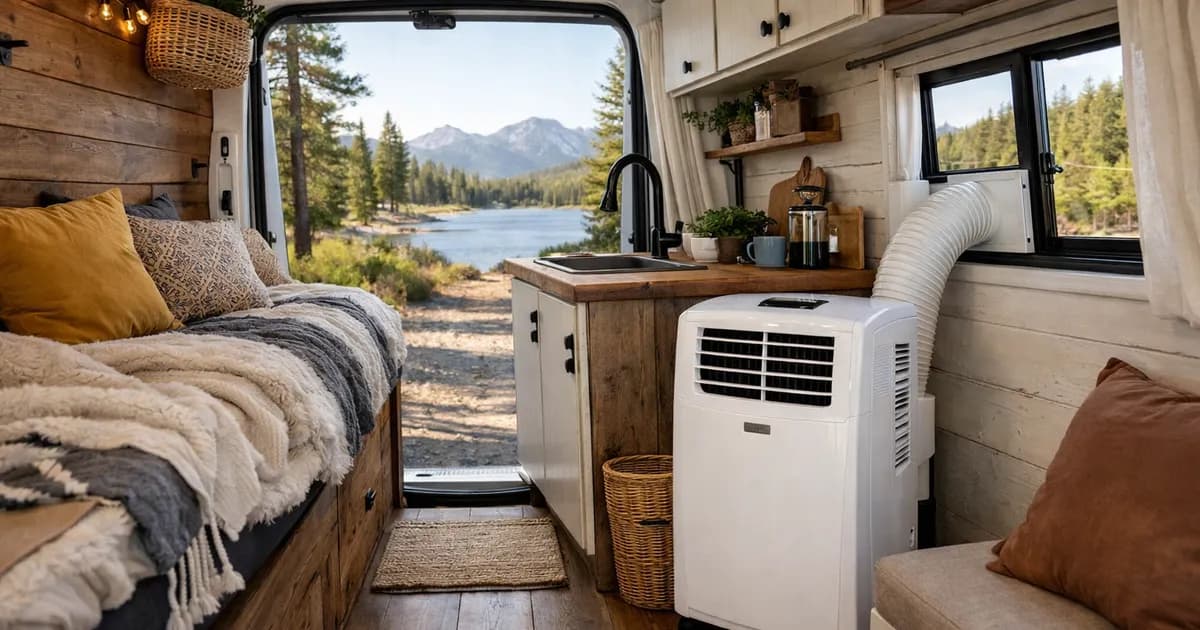
It depends on what you mean by portable air conditioner. If it's a compressor unit with an exhaust hose, yes, it really cools a motorhome. If it's one of those €80 gadgets with no hose that run on water and ice, that's not an air conditioner — it's a fan with a humidifier, and it won't lower the cabin temperature even by a degree on a genuinely hot day.
What's the difference between a portable air conditioner and an evaporative cooler?
This is where a lot of people end up wasting money. Online stores mix together two completely different products under the same label, and only one of them truly cools.
A real portable air conditioner has a compressor, refrigerant gas, a condensation circuit, and an exhaust hose that vents hot air outside. It works on the same principle as the AC in your house. It draws between 400 and 900 watts continuously, weighs 20 to 30 kilos, and needs an open window or a modified roof hatch to run the hose outside. It really cools, drops the cabin temperature by several degrees, and also dehumidifies.
An evaporative cooler, by contrast, has no compressor. It pushes air through a sponge or filter soaked with water and ice, and the air comes out a little cooler thanks to evaporation. The catch is that it only works properly in dry air. In a small cabin like a motorhome, you fill the air with moisture in fifteen minutes, and after that it stops cooling even the small amount it managed at first. It uses very little power, that's true, and costs between €50 and €150, but don't call it an air conditioner, because it isn't one.
The easy rule for spotting the difference in a listing: if it doesn't have an exhaust hose to the outside, it's not an air conditioner. It's an expensive fan.
How many BTU do you need based on the size of your motorhome?
BTU is the unit used to measure cooling capacity. The higher the BTU, the more volume the unit can cool. But bigger is not always better, because every extra BTU costs you in power, weight, and space.
- Small camper van or compact panel van (under 15 m³): 2,000 to 3,000 BTU is enough. Models like the Mestic SPA-3000 fall into this range and usually cost around €500 to €700.
- Medium low-profile or overcab motorhome (15 to 25 m³): you need 3,000 to 5,000 BTU. This is where units like the Mestic SPA-5100 or top-end Cecotec ForceClima models fit, usually between €300 and €800.
- Large integral motorhome (over 25 m³): a portable unit starts to fall short. You can fit a 7,000 BTU model like the Cecotec ForceClima 7100, but at that point a fixed roof unit is usually the smarter choice.
Buying a 12,000 BTU household air conditioner because more must be better is a common mistake. It's heavy, it uses more than twice as much power, and in a small cabin it switches on and off every couple of minutes because it cools too quickly, which shortens the compressor's life.
Can you use a portable air conditioner without being plugged in at a campsite?
This is the question most people ask, and the one that's answered worst online. The short answer is: with a conventional 220V portable unit, practically no. With a 12V unit designed for motorhomes, yes, but the price goes way up.
A conventional portable air conditioner draws between 400 and 900 watts continuously. To run it off-grid, you need at least a 1,500-watt inverter and a sizeable lithium battery bank, at least 200 Ah at 12V, and even then you'd only get three or four hours of use. With normal-sized solar panels (200 to 400 W), you won't replenish what the air conditioner uses during the day, so after two days without shore power you'll be out of battery.
Air conditioners designed to run directly on 12V without an inverter, such as the Dometic RTX or EcoFlow Wave, are built for autonomy. They use less power, make battery use more efficient, and can be used on the road or when wild camping. The downside is the price: between €1,500 and €3,000 for the unit alone, not counting installation if it's going on the roof.
If your plan is to use campsites with hookups, a 220V portable unit for €400 to €700 will do the job. If you plan to sleep in places without electricity or wild camp in summer, you either need a serious electrical setup or the portable unit will disappoint you on the first hot day on the road.
How much noise does a portable air conditioner make, and can you sleep with it on?
Portable compressor units make noise. There's no way around it: you can hear a compressor running half a metre from your head. Mid-range models measure between 45 and 55 decibels in normal mode, and between 40 and 48 in night mode, if they have one. For comparison, a normal conversation is around 60 decibels and a modern fridge is about 40.
Real-world feedback from users, which you can read in forums like Webcampista or Forodecampistas, is that most people sleep with the unit on, get used to the noise, and treat it like white noise. But some people can't stand it and end up switching it off at midnight. If you're a light sleeper, try it before you buy.
Two practical tips: if you plan to install it semi-permanently inside a cabinet, line the compartment with closed-cell foam like Kaiflex to reduce vibration transfer. And never place the exhaust hose near the unit's own air intake, because it will recirculate hot air and the compressor will cycle twice as often.
Is it worth buying a portable air conditioner, or is a fixed roof unit better?
There's no single answer — it depends on how you use the motorhome. A portable unit has clear advantages: you can install it yourself, you don't have to drill the roof, you can remove it in winter and recover the space, and it costs about half as much. The drawbacks are just as clear: it takes up space inside, makes more noise, only works on 220V shore power, and needs an open window for the hose.
A fixed roof air conditioner like the Dometic FreshJet or the Truma Aventa is integrated, doesn't take up interior space, is quieter because the compressor is outside, and some models run on 12V. In return, installation costs around €1,500 to €3,000, adds 25 to 35 kilos to the roof, and if the compressor fails, repairs are expensive.
The honest recommendation: if you use the motorhome for less than a month a year and mostly stay at campsites with hookups, the portable unit is more than enough. If you spend several months a year on the road or stay in southern Spain in August, the fixed unit makes more sense in the long run. And if you're thinking about buying a used motorhome, check which system it has before you set your budget: a well-kept Truma or Dometic fixed unit adds real value, while a half-installed unit from an unknown brand is a future headache.
What should you check on the air conditioner when viewing a used motorhome?
If you're viewing a motorhome and they tell you it has air conditioning, don't stop at the claim. Run through these checks during the visit, just like when doing a proper used motorhome inspection, because repairing a broken AC can cost anywhere from €400 to €3,000 depending on the type and the fault.
- Switch it on and let it run for at least 15 minutes. Check that it blows genuinely cold air, not just that the fan spins. If the interior temperature hasn't dropped after a quarter of an hour, something is wrong.
- Look at the exhaust hose if it's portable, or the exterior grille if it's a roof unit. Rusted or bent grilles, broken or patched hoses are signs of poor installation or poor maintenance.
- Ask when the refrigerant was last topped up. Motorhome air conditioners lose gas over time, just like car units. A recharge costs between €60 and €120.
- Make sure the remote works and that all modes — cool, fan, and dehumidify — respond properly.
- Pay attention to the start-up noise. A loud clunk or an irregular start usually means the compressor is worn, and that is a serious repair.
And be careful with motorhomes that have a living-room portable unit jammed into a cabinet. Sometimes it's not really an installation at all, just the previous owner's DIY fix. Check that the electrical outlet can handle the unit's power draw and that there are no exposed wires or home-made connections. When you're reviewing the key points before buying a used motorhome, climate control belongs in the cabin systems section, along with the fridge, heating, and water.
If the portable unit is part of the budget for a full tune-up, add it to the total before you agree on the price. And if you already have one and you're wondering whether to replace it with a fixed unit, only do it when you know you'll make up the difference with real hours of use. With AskPancho, you can check the condition of the air conditioner and the rest of the motorhome systems step by step while it's right in front of you, with questions adapted to the exact model. Don't let a cheap buy turn into an expensive mistake.