
How to Inspect a Used Car Before Buying It
Checking a used car properly before buying it does not require being a mechanic. It requires a methodical approach, time, and not letting yourself be rushed by the pressure to hurry. Most problems can be detected by paying attention to the right things. This guide tells you exactly what to look for, in what order, and why.
What should I prepare at home before going to see a used car?
Don't go to see a car without knowing what you're looking at. Research the model, learn about the most common used car problems, what usually fails over time, and how much repairs tend to cost. With that information, the questions you ask the seller will be much better.
Before you go:
- Ask for detailed photos: the underbody, the engine bay, the interior without flattering angles, and the instrument cluster switched on. If the listing only has three nice photos, ask for more. The photos the seller does not want to send are usually the most revealing.
- Ask for the license plate: with it, you can verify vehicle information without leaving your couch: mileage records from the state inspection, whether there are any outstanding liens, and whether it has been reported stolen.
- Ask for invoices from recent repairs: a well-maintained car has paperwork. If it doesn't, you cannot verify anything you are told. And what is not verified, you will end up paying for.
- Research the model's weak points: 15 minutes in model-specific forums can give you a list of common problems that you can then check in person.
Why is it important to see the car in natural light and without rushing?
At midday and outdoors whenever possible. In low light, dents, paint differences, and rust can go unnoticed. A seller who wants to hide a bodywork defect knows that low light makes it harder to see.
Give yourself plenty of time. If you arrive in a hurry, you will only glance over the car and make a quick decision. Fast decisions with used cars are expensive mistakes. Block out at least two hours for the full visit: visual inspection, test drive, document review, and a conversation with the seller.
If you can bring someone you trust, even better. A second person notices things you miss when you're focused on one area of the car. And if you go with a mechanic you trust, the visit is worth twice what it costs.
What should I look for in the bodywork and engine inspection?
The seller shows you the good parts. Your job is to look for what they are not showing you.
- Bodywork: look at it from different angles and check for differences in paint tone. If one panel is a slightly different color from the one next to it, it has been repainted. Pay attention to the gaps between panels: if they are not even or symmetrical, the car may have been in a crash. Run your hand over the surfaces: a repainted area has a different texture to the touch.
- Underbody: crouch down and look underneath the car for rust, oil or fluid stains, loose parts, or anything hanging down. Wheel arches and the lower edges of the doors are areas where rust often appears first.
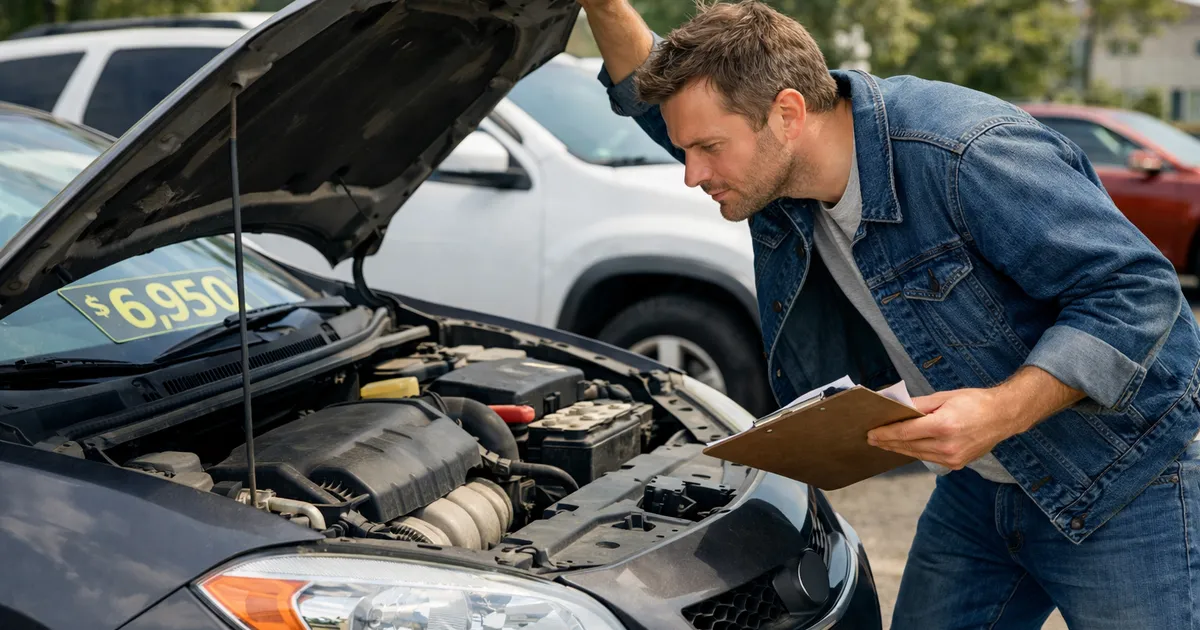
- Engine: open the hood and check the oil and coolant levels. The oil should be dark but clean. If it looks creamy, like mayonnaise, on the filler cap, fluids may be mixing, which is a serious problem. Look for leaks, loose wires, and cracked hoses.
- Trunk: lift the floor mats and look for dampness, rust spots, or dried mud. A damp trunk can indicate leaks through window seals or body damage.
Why is it so important to start the car cold?
Ask them not to start it before you arrive. A cold engine tells you things a warm one hides: difficulty starting, strange noises when turning over, or smoke on startup. If the engine is already warm when you arrive, ask yourself why. A seller who warms up the engine before you get there may be trying to hide a starting problem.
When starting cold, pay attention to the exhaust smoke color: persistent white smoke may indicate a blown head gasket, blue smoke suggests oil consumption, and black smoke indicates too much fuel. A little white vapor on cold days is normal and disappears within a minute.
Also watch the idle once it starts. It should be steady and smooth, without fluctuations. An uneven idle can indicate injection, throttle body, or valve problems that are not visible at first glance.
What should I test during a used car test drive?
A quick lap around the block is not enough. Drive for at least 15 to 20 minutes in both city and highway conditions. Go up a hill. The test drive is where most problems are discovered, because many faults only show up while the car is moving.
- Gears: shift through every gear, including reverse. Listen for any gear that is hard to engage, noisy, or grinds.
- Brakes: brake firmly in a straight line. The car should stop straight without pulling to either side. The pedal should feel firm, not spongy.
- Steering: gently release the steering wheel on a straight road. If the car pulls to one side, there is an alignment issue or something worse.
- Suspension: drive over bumps and listen for sharp knocks, metallic noises, or an excessively soft ride.
- Electronics: test the air conditioning (leave it on for 10 minutes to see if it really cools), heating, lights, power windows, central locking, radio, and Bluetooth.
- Clutch: accelerate in higher gears (fourth or fifth) at moderate speed. If the revs rise but the speed does not follow, the clutch is slipping.
What documents do I need to check before buying a used car privately?
Paperwork is not the most exciting part, but it is the part that saves you from the most problems.
- Vehicle title or registration document: make sure it matches the actual car (make, model, VIN, power output).
- Valid state inspection: if it has expired, you will have to pass it yourself, and that can cost money if the car is not ready.
- Liens and outstanding debts: request a DMV vehicle history report. Do not buy a car without knowing whether there are any outstanding liens.
- Maintenance history: the mileage on repair shop invoices should match the odometer and the inspection records.
- Vehicle identification number (VIN): make sure it matches on the paperwork, the dashboard plate, and the door frame.
If the VIN does not match in all places, do not buy that car. It may have been tampered with, or it may be a vehicle with a problematic history that someone is trying to hide by changing the paperwork.
What should I do if the seller pressures me or makes excuses?
A seller who rushes you, does not let you test something, or makes excuses not to show you the paperwork is hiding a problem. Do not let someone else’s urgency dictate your decision. If you have doubts, go home and think it over. A good car will still be a good car tomorrow. And if the seller says another buyer is waiting, let them wait. If that is true, they will sell it anyway. If it is not true, it is just pressure tactics you should not fall for.
How can I do all this without being a mechanic?
You do not have to remember all of this by heart. With AskPancho, you can inspect the car step by step while standing right in front of it. You tell Pancho which car you are going to see, and it guides you with questions tailored to the model and year, asks for specific photos of that exact car's critical points, and gives you a detailed report with a score and recommendations. That way, you go into the negotiation with real data, not just the seller's word.