
How Often Should You Change Used Motorhome Tyres, Even If They Look New?
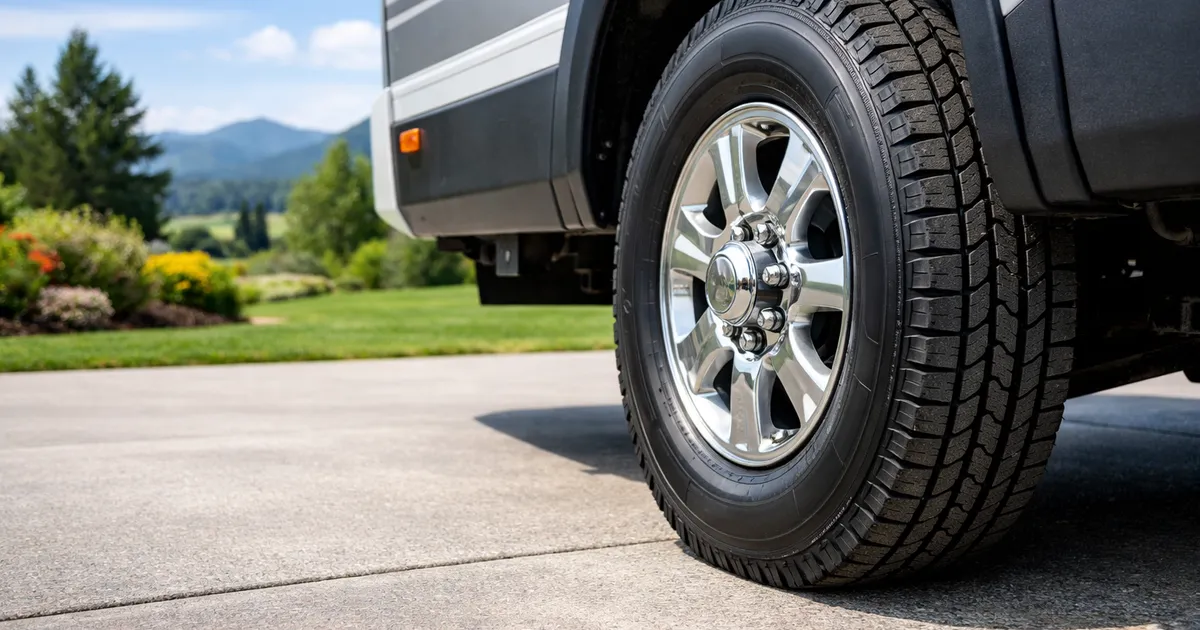
Tyres on a motorhome can be deceptive. They may have plenty of tread and look barely used, but if they are more than 5 or 6 years old, the rubber has already lost elasticity and grip. And on a vehicle that weighs more than 3,000 kilos, that is a serious risk. Don’t trust the appearance: trust the date.
Why do motorhome tyres age even when they are barely used?
Motorhomes do not move as much as cars. Many cover just 5,000 or 10,000 kilometers a year, so the tyre tread hardly wears down. But the rubber still deteriorates over time due to sunlight, temperature changes and the vehicle’s own weight sitting on stationary tyres. After 5 or 6 years, a tyre starts to lose its properties regardless of how it looks.
The problem is that this deterioration is not always visible to the naked eye. A tyre can look immaculate, but the rubber no longer behaves the way it did when it was new. This is especially dangerous in motorhomes because the vehicle takes much longer to brake, has a high center of gravity and any loss of control at highway speed can have very serious consequences.
How to tell the real age of a motorhome tyre
On the sidewall of each tyre there is a code that starts with DOT. The last four digits tell you the week and year of manufacture. For example, 2319 means it was made in week 23 of 2019. If those four digits show that the tyre is more than 6 years old, consider replacing it even if it looks perfect.
- The DOT code is on the tyre sidewall, sometimes on the inner side (you may need to crouch down to see it).
- Check all four tyres separately: it is not unusual for them to have different dates.
- If the motorhome has a spare tyre, check its date as well. A 10-year-old spare is useless in an emergency.
- Tyres stored in dark, dry garages age more slowly than those exposed to the sun. But once they are 6 years old, it is wise to inspect them very carefully and consider replacing them, regardless of storage conditions.
What can happen if you drive on old tyres in a motorhome?
An aged tyre loses grip, especially on wet roads and during emergency braking. Braking distance can increase by several meters compared with a new tyre, which on a heavy motorhome can be the difference between a close call and an accident.
It is also more likely to suffer a blowout, which in a motorhome at highway speed is extremely dangerous because of the vehicle’s weight and high center of gravity. Blowouts caused by aged tyres can lead to serious accidents in motorhomes. This is not a hypothetical risk: it happens, and when it happens at 110 km/h with a home on top, the consequences are severe.
How to detect roof damp in a used motorhome and spot tyre ageing
There are visual and tactile signs you can check yourself without any tools:
- Cracks in the sidewall. If you see fine cracks in the rubber on the sidewall, even if they are small, the rubber is drying out. Any visible crack is enough reason to replace the tyre.
- Grayish or dull color. A new tyre is deep black. If the rubber has lost its color and looks grayish or dull, it has started to deteriorate.
- Hard tread. Run your hand over the tread. If it feels hard and not very flexible, it has lost its properties even if the tread pattern is still intact.
- Sidewall deformities. Any bulge or deformation in the tyre sidewall is a warning sign of an imminent blowout. Do not wait: replace that tyre before the next trip.
How many miles does a used motorhome last, and how much does tyre replacement cost?
Motorhome tyres are not cheap. Depending on the size and brand, a set of four tyres can cost between 400 and 1,000 euros, plus fitting and balancing. It is a significant expense, but compared with the cost of a blowout (body damage, loss of control, accident), it is a safety investment.
If you are buying a first used motorhome, tyres are one of the first things you should check, and one of the things most people overlook. Check the manufacturing date of all four tyres (including the spare, if it has one). If they are more than 5 years old, add the cost of a new set to the purchase price. It is an expense that is going to come up one way or another, and it is better to factor it in before negotiating than to discover it later, so you do not fall for the mistakes that make you lose money.
How to check a used motorhome grey water tank and the spare tyre storage
Yes, and it is one of the most overlooked points. The spare tyre in a motorhome often sits unused for years, stored in a compartment under the chassis or mounted at the rear. In that position, it may be exposed to more sun, moisture or temperature swings than the tyres in use, and its DOT date may be even older than the four main tyres.
Make sure the spare tyre is properly inflated, has no sidewall cracks and that its DOT date is no more than 6 years old. A spare in poor condition is useless when a blowout happens on a mountain road 200 kilometers from the nearest workshop. Also check that the jack, wheel wrench and valve adapter are in place and usable: the change tools are just as important as the spare tyre itself.
With AskPancho you can inspect the motorhome point by point, including the tyres. Pancho reminds you to check the DOT date and helps you assess the vehicle’s real condition. Cheap should not end up expensive.