
Can You Live in a Motorhome in Winter?
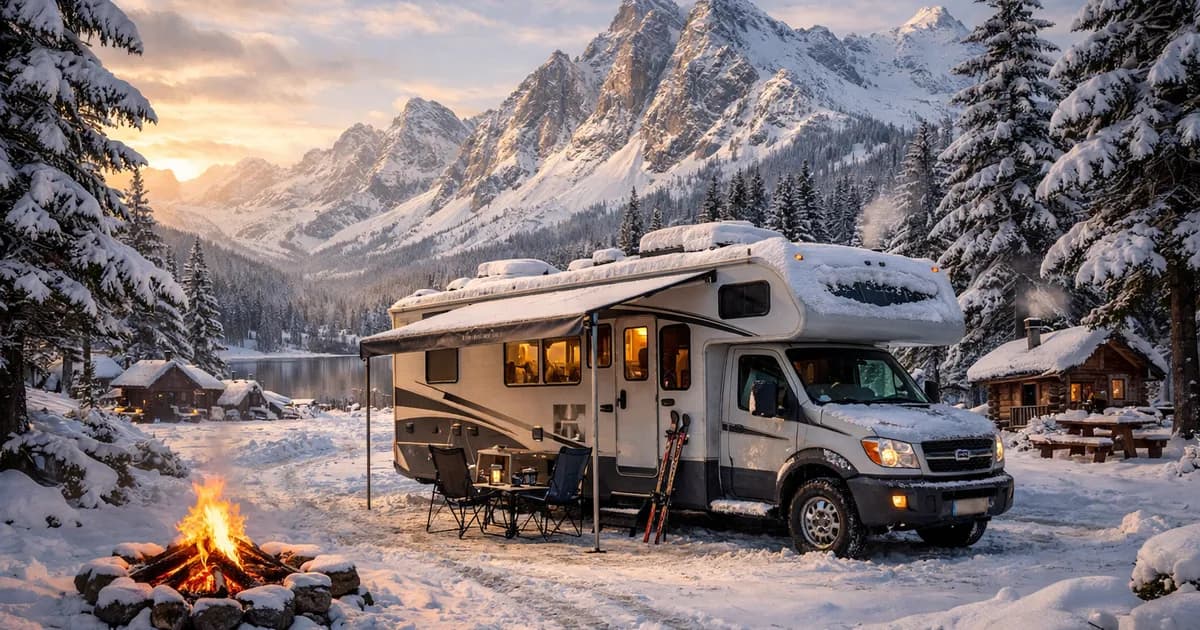
Yes, you can live in a motorhome in winter — but not just any one. A motorhome built for winter use needs strong heating, water tanks protected from freezing, real insulation, and preferably a double floor. If you're buying a used one because you plan to spend cold seasons in it or live in it full time, there are very specific things to check before you pay. Buy the wrong motorhome for winter and you're looking at burst pipes, ice on the inside of the walls, and nights at 50°F.
Can you live in a motorhome in winter?
It depends on two things: the motorhome and the temperatures you expect. A motorhome designed for winter use — premium German manufacturers, a PUAL-insulated body, double floor, properly sized heating — can keep the inside at 68°F even when it's 32°F outside, snow on the roof and all. A mid-range summer motorhome can become a problem below 41°F: the floor gets cold, the tanks freeze, and the heating can't keep up.
There's a big difference between spending a week skiing in the Pyrenees and living in a motorhome for three months a year. For occasional use in mild temperatures, any decent model will do. For heavy use in cold climates — northern Spain, ski resorts, van life with remote work in mountain areas — you need a vehicle built for the job.
The key question before you buy isn't whether you can live in a motorhome in winter. It's whether you can live in winter in that specific motorhome. And that has to be decided before you pay, not after.
What does it mean for a motorhome to be certified for winter?
There is a European standard, EN 1646-1 for motorhomes (and EN 1645-1 for caravans), that classifies vehicles according to how they perform in the cold. There are three certification grades, and what sets them apart is how well they can heat the interior from different outside temperatures.
- Grade I: no specific cold-weather requirements. Pure summer use.
- Grade II (winter-resistant): from 32°F outside, the heating must bring the living area up to 68°F in two hours. Suitable for autumn trips and mild winters.
- Grade III (winter-proof): from 5°F outside, the heating must bring the living area up to 68°F in four hours, and the water system must keep working without freezing. This is the grade you need for serious winter use.
The official test has four stages: cooling the motorhome down to the starting temperature for ten hours with doors and windows open, switching on the heating and measuring the time it takes to reach 68°F, stabilizing it with full tanks, and a final water-system test to confirm that nothing has frozen.
Manufacturers usually list the grade in the technical sheet or catalog. If a used motorhome says it has Grade III certification, ask to see the document that proves it. If the seller doesn't know the grade, it's probably not certified and you'll need to judge it from the equipment.
What winter equipment should a used motorhome have?
If the motorhome doesn't come with Grade III certification, the equipment tells you whether it's really winter-ready or just marketing fluff in the ad.
- Double floor: this is the feature that most clearly separates a winter motorhome from a summer one. It's a hollow technical floor where the water tanks, pipes, and sometimes part of the heating system go. The double floor is heated and keeps the tanks above freezing without you having to worry about it.
- Interior or heated tanks: if there is no double floor, the fresh-water and grey-water tanks should be inside the living area or fitted with heating elements. Unheated external tanks will freeze after one night at 27°F.
- Properly sized heating: for real winter use you need a Truma Combi 6 (6 kW) or Alde hot-water system, not a Truma Combi 4 (4 kW) or a small parking heater. In large motorhomes, a Combi 4 falls short as soon as temperatures drop below freezing.
- Real insulation: bodies built with PUAL construction (extruded polyurethane with inner and outer layers without wood) handle cold better than traditional wooden-frame builds. Hymer, Carthago, top-end Bürstner, and Frankia use systems like these.
- Double glazing on all windows: single-pane windows let in the cold and condense heavily. Double-glazed acrylic windows with an air gap are standard on serious motorhomes.
- Well-sealed roof hatches: in winter, roof hatches are one of the biggest sources of heat loss. Good ones have triple insulation and a tight seal.
If the vehicle doesn't have a double floor, it can still work for mild winters, but the risk of water-related problems rises sharply as soon as temperatures drop at night. If you're living in it, the double floor stops being optional.
What should you check when buying a motorhome for winter use?
In addition to the general points of any inspection, there are specific checks to make when you plan to use it in winter.
- Turn on the heating and wait for it to really start working. With a Truma Combi or Alde, ask the seller to have it running from the moment you arrive. If it takes more than an hour to properly warm the interior with moderate outside temperatures, it will perform worse in real winter conditions.
- Check the condition of the seals on doors, windows, and roof hatches. If they're dry or cracked in autumn, cold air and moisture will get in during winter. It's a manageable repair, but it needs to be in the budget.
- Check whether the water tanks are insulated or heated. Look underneath the vehicle and inside the technical compartment. External tanks without insulation are a no-go for winter.
- Look for damp in a used motorhome, especially in the roof corners, around roof hatches, and at the lower edges of the walls. In motorhomes used hard in winter, damp tends to build up in those areas because of condensation.
- Check the condition of the leisure battery. In winter, gas heating needs electricity to work (the internal fan is electric). A tired leisure battery can leave you without heating even if you have gas.
- Ask whether the gas setup has an automatic changeover system between bottles. In winter you use much more gas, and running out of heating at 3 a.m. because one bottle is empty is a very real problem.
- Check the gas inspection certificate. Make sure it's still valid. If it's expired, factor it into the cost of getting the motorhome ready.
And here's a winter-specific check: ask the seller whether they've used the motorhome in sub-zero temperatures and how it handled them. A concrete answer — for example, 'I had it for a week in the Pyrenees at 18°F and it used half a bottle a day, but nothing froze' — is a good sign. A vague answer like 'it holds up fine' usually means they never tested it.
What tyres and rules does a motorhome need in winter?
If you're driving in winter through snowy areas, tyres are not optional. There are two markings you need to know.
The M+S marking (Mud and Snow) is the older one. It means the tyre has a tread pattern suited to mud and snow, but there are no standardized tests behind it. In Spain and most European countries, M+S is generally accepted as a winter tyre, but not everywhere.
The 3PMSF marking (Three Peak Mountain Snowflake), shown as a mountain with three peaks and a snowflake, is officially certified under the European UNECE R117 regulation. These tyres have passed standardized braking and traction tests on snow and carry the 3PMSF mark.
Country rules for European motorhomes:
- Spain: M+S tyres or chains if required by the authorities in snowy areas.
- France (Mountain Law): M+S, 3PMSF, or chains in 48 mountain departments between November 1 and March 31.
- Austria: M+S tyres or chains between November 1 and April 15.
- Italy: M+S tyres or chains between November 15 and April 15.
- Germany: 3PMSF is mandatory in winter conditions (snow, ice, sleet).
- Sweden: check the current rules before you travel.
If the used motorhome comes with summer tyres and your plan is winter use, add a full set of 3PMSF tyres to your budget — roughly €800 to €1,500 depending on size and brand. And keep in mind that tyres age even when they aren't used: if the ones on it are more than five or six years old, replace them anyway, even if they look fine.
Which used motorhomes are good for winter?
Not all brands build with the same cold-weather standards. If you're looking for serious winter use in a used motorhome, there are a few names worth checking first.
- Hymer: many Hymer motorhomes are designed for cold climates, with PUAL construction and strong insulation. They're a benchmark in the market.
- Carthago: premium motorhomes with heated double floors and reinforced insulation. Their higher-end ranges are made for winter use.
- Frankia: a high-end German manufacturer with cold-climate construction and very careful finishing.
- Bürstner higher-end ranges (Aviano, Delfin, Nexxo): good winter options within a brand with a wide lineup.
- Dethleffs higher-end ranges (Globebus, Esprit, Trend): designed for extended use in cold weather.
- Niesmann+Bischoff: a premium maker of integrated motorhomes built for wintering in comfort.
Brands like Chausson, Benimar, Sunlight, Carado, or Ilusión are perfectly decent, but they tend to be aimed at summer use or mild winters only (Grade II at most). They aren't bad buys, but if your plan is to live in the motorhome for three months a year or head regularly to ski resorts, you'll probably find them lacking.
Price reflects that difference. A 5-year-old Hymer integrated motorhome usually sells used for around €60,000 to €90,000. A comparable mid-range coachbuilt usually sits around €35,000 to €55,000. The difference isn't just the badge — it's real insulation capacity and equipment.
If you're buying a motorhome specifically for winter, don't try to save money in this category, because fixing it later — adding a double floor, replacing the heating, changing tanks — is far more expensive than buying the right one from the start. With AskPancho, you can inspect a used motorhome step by step with questions tailored to the exact model and the kind of use you plan to give it, including the specific points for winter use. And if you need help negotiating the price, learn how to negotiate with concrete data on the table. Cheap shouldn't end up costing you more.